Price & Royalties
How to Price Your Ebook by Genre and Goal
$0.99 maximizes units, $4.99 maximizes fiction revenue, $7.99–$9.99 signals nonfiction expertise. Price for the goal you actually have.
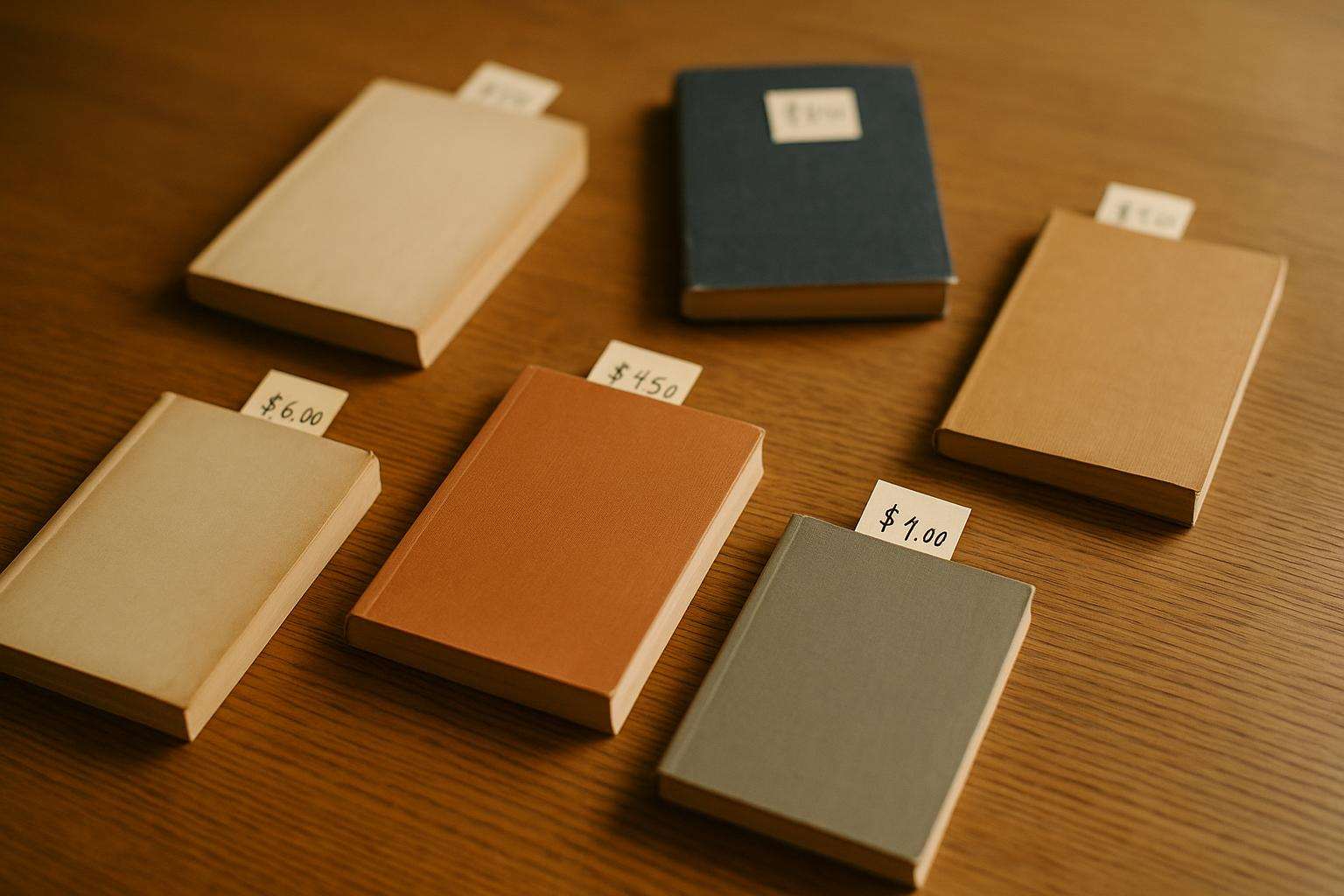
Most ebook pricing advice gives you a single number and stops there. The real answer is a matrix: the right price depends on your goal, your genre's median, and the royalty structure Amazon enforces. Set it wrong and you can give away 35 cents on every dollar without ever seeing the line item. Set it right — for the goal you actually have, inside the genre your readers already shop — and you earn more on fewer copies than an author who priced by feel.
The foundation is the same for every book. Amazon KDP pays a 70% royalty only between $2.99 and $9.99. Below that band or above it, the rate drops to 35%, and the math is severe. A $0.99 ebook earns about $0.35 per sale; a $2.99 ebook earns about $2.03. To match that $2.99 revenue at $0.99, you need roughly six times as many sales. According to Amazon's official KDP royalty documentation, this band has been in place since the platform launched and governs every price decision discussed below. Everything in this article operates inside that band, because the band is where the income is.
Price for the goal, not the feeling. $0.99 maximizes unit volume (roughly 2× any other price point, but at 35% royalty and a $0.35 per-sale yield). $3.99–$4.99 is the fiction revenue sweet spot — more units and more dollars than any higher price in the top-500 Author Earnings dataset. $7.99–$9.99 is the nonfiction authority ceiling, where price signals expertise and earns near the 70% maximum before the $9.99 royalty cliff. Genre medians override all of these defaults whenever the two conflict.
Which price maximizes fiction revenue — and does it match your genre?
Genre price ranges are real. They represent the equilibrium point where thousands of real buyers, in a real subcategory, have already voted with their wallets. A new author who prices above the genre ceiling can write a better book than every comp and still underperform, because the sticker price argues against them before a single page is read. Here are the ranges the 2025–2026 data supports:
| Genre | Typical full-price range | Notes |
|---|---|---|
| Romance | $2.99–$4.99 | Highly price-sensitive; small increases above $4.99 cause measurable sales drops |
| Thriller / Mystery | $3.99–$5.99 | ~40% of Kindle Top 100 mystery/thriller titles price at or below $3.99 |
| Fantasy / Sci-Fi | $4.99–$6.99 | Higher proportion of titles above $4.99 than romance or thriller |
| Literary Fiction | $4.99–$9.99 | Slower promotional cadence, lower overall volume |
| General Nonfiction (how-to) | $5.99–$9.99 | Most indie titles cluster toward the upper end of the 70% royalty band |
| Prescriptive Nonfiction (business, health) | $7.99–$9.99 | The acknowledged sweet spot for expertise signal and maximum royalty yield |
Within fiction, the data points to a specific sweet spot. When the Author Earnings analysis examined the top 500 best sellers at each price point — stripping the top ten outliers so breakouts could not skew the result — $4.99 generated more units and more gross dollars than any higher price, including $9.99, $12.99, and $14.99. It produced roughly two-thirds again the revenue of $9.99 titles. That is the rare price where the two things you usually trade against each other — volume and margin — pull in the same direction.
The Smashwords annual surveys of real sales, covering $25 million in transactions across four consecutive years, found $3.99 to be the top price for both unit sales and earnings for full-length indie fiction. The 2023 Written Word Media trend data shifted the consensus slightly toward $4.99 as the fiction revenue optimum — the first year $4.99 overtook $3.99 as the most common high-price point among indie authors with multiple titles. The range $3.99–$4.99 is, in short, the empirically supported target for standalone fiction. Verify it against your specific subcategory's live top ten before you commit, because genre norms shift season by season.
Does cutting your price to $0.99 actually sell more books?
Sometimes — but not always, and rarely in the way the unit count suggests. The broad-market data from Written Word Media's 14,620-title dataset shows $0.99 moves roughly twice as many copies as any other price point. The problem is that it also pays only 35% royalty, so you need about six times the $2.99 volume just to match that book's revenue. For a standalone book as a permanent price, the arithmetic almost never closes.
More critically, the assumption that cheaper always outsells more expensive breaks down at the genre level. A horror and paranormal author documented that $0.99 and $1.99 underperformed $2.99–$3.99 in unit sales — low price signaled low quality in a genre where readers have learned to associate rock-bottom pricing with thin content. The demand curve was an inverted U: too cheap was as bad as too expensive, and the optimum sat firmly in the middle of the range. This is not a theoretical concern. It is what happened in a documented real-world case.
The structural worst point on the entire curve is not $0.99. It is $1.99. The Smashwords annual survey, repeated across four consecutive years of actual sales data, found $1.99 earned authors 73% less than the average of every other price point. It sells fewer copies than $0.99 and still pays only the 35% royalty, losing on volume and on margin at the same time. If you are considering a price below $2.99, your real choices are $0.99 (as a deliberate series funnel entry or a Kindle Countdown Deal tool) or stay at $2.99 and above. The ground between them is where money goes to die.
One more constraint to name explicitly: in 2025, the $0.99–$1.99 price range became increasingly associated with AI-generated content across all genres. Pricing at $2.99 and above now signals human authorship in addition to signaling professional investment. For nonfiction, $0.99 has always argued against the author's expertise; in 2025, it started arguing against their humanity as well.
How should nonfiction ebook prices signal expertise differently?
Fiction and nonfiction pricing diverge because their readers are buying fundamentally different things. A fiction reader is buying an evening. A nonfiction reader is buying a solution — one they often expect to pay them back in time saved, money earned, or pain reduced. That changes the psychology of price completely: a low price in nonfiction signals not a bargain but a thin, untested book, and no amount of copywriting overcomes it.
The Nonfiction Authors Association identifies $7.99–$9.99 as the sweet spot for prescriptive nonfiction on Amazon: business, health, how-to. This is the zone where price signals expertise and the 70% royalty is still fully in play. A documented case study from HMD Publishing illustrates the principle: a business nonfiction ebook raised from $6.99 to $8.99 with a paperback anchored at $18.99 saw no change in conversion rate whatsoever. The readers in that category were not price-shopping; they were credibility-shopping. The price increase was pure margin improvement with zero sales loss.
Nonfiction demand also shows measurably different elasticity from fiction. Research aggregated across the category puts it near -1.5: a 10% price increase sheds only about 15% of units, a far gentler slope than most fiction genres ride. That gentler slope is why nonfiction authors can push toward the $9.99 ceiling without losing most of their audience — and why an author who underprices at $2.99 or $3.99 forfeits both revenue and credibility simultaneously.
The $9.99 ceiling is hard. At $9.99 you earn about $6.89 per sale. At $10.99 the royalty falls to 35% and earnings drop to about $3.85 — a $3.04 loss for every copy despite charging more. To match the $9.99 yield at the 35% rate, you would need to charge roughly $19.69. Reserve pricing above $9.99 for direct-to-consumer channels — your own Gumroad or Payhip store — where no royalty cap applies and you can price at $14.99, $24.99, or whatever the market will support.
What is goal-conditional pricing and how do you pick your goal?
Name the goal before you name the number. Three different goals pull a price in three different directions, and a price that is right for one is wrong for both others. The table below maps each goal to its optimal price, its royalty rate, and the author it actually fits:
| Goal | Best price point | Royalty rate / earnings per sale | Who it fits |
|---|---|---|---|
| Maximum unit volume | $0.99 | 35% (~$0.35/sale) | Fiction series Book 1 as a loss-leader funnel; never standalone nonfiction |
| Maximum fiction revenue | $3.99–$4.99 | 70% (~$2.72–$3.44/sale) | Full-length standalone fiction or later-in-series titles |
| Maximum nonfiction authority | $7.99–$9.99 | 70% (~$5.49–$6.89/sale) | Prescriptive how-to, business, and health nonfiction |
Once the goal is named, charm pricing operates across all three. A 2024 study of 50,000 KDP books found that $2.99 outsold identical titles at $3.00 by an average of 11.3%, because readers anchor on the leftmost digit and mentally file $2.99 as “two dollars.” Cross from $4.99 to $5.00 and a measurable 4.5% conversion drop follows for that single penny. The overall charm pricing lift — ending a price in .99 rather than a round dollar — runs 8–25% across documented studies. The practical rule is simple and firm: $2.99, $3.99, $4.99, $7.99, $9.99 — never $3.00, $5.00, or $10.00. The penny you save the reader by rounding is the cheapest conversion you will ever buy.
How do you test whether your genre price is right?
Genre benchmarks and elasticity studies tell you the shape of the curve. Only your own data reveals where on it your book sits. The discipline that survives every market shift is sequential price testing: hold a price for 30 days, record price times units sold, move a dollar in either direction, and hold again for another 30 days. The winner is the most total revenue — not the most copies, not the proudest number on the page.
A political thriller author ran exactly this experiment, testing every dollar increment from $2.99 to $8.99 in 3–8-week windows across a full year. The result was counter-intuitive: volume held nearly flat from $2.99 all the way to $6.99, then dropped sharply at $7.99 and never recovered — a sustained 28% volume decline not compensated by higher royalties. The author's revenue optimum sat at $5.99–$6.99, not at the universal defaults. The relevant ceiling was genre-specific, revealed only by testing. This is the method, and its conclusion applies to your book as well: the right price is the one your readers vote for, and they vote with completed purchases over a 30-day window, not with opinions.
Before you test, do the foundational comp research. Pull the top 10 titles in your exact sub-category — not the parent — and read their live prices. As a new author, sit at or just below the median of that cluster. Do not change price more than once every two to three weeks outside deliberate promotional campaigns. Amazon's algorithm may penalize rapid price cycling, and you need a genuine data window — not three days of noise — to distinguish a real demand signal from a seasonal fluctuation. Launch slightly above your instinctive comfort price: reducing price post-launch is simple; increasing it is psychologically difficult and disappoints early buyers who expected the launch price to hold. Set the number, hold it long enough to see the data, and update on what the data says, not what another author's screenshot looked like on a single good weekend.
Frequently asked
Does pricing my ebook at $0.99 maximize revenue or just unit count?
It maximizes unit count, not revenue. At $0.99, Amazon KDP pays the 35% royalty — roughly $0.35 per sale. At $2.99 you earn the 70% rate, about $2.03 per sale. That means you need approximately six copies sold at $0.99 to match the revenue of a single $2.99 sale. For a standalone book, the arithmetic almost never closes in your favor. The one legitimate use for $0.99 is as a series funnel entry — Book 1 priced low to win a reader who buys Books 2–N at full price. Even then, a Kindle Countdown Deal at $0.99 keeps the 70% royalty (~$0.69/sale) and nearly doubles per-sale income versus a flat price drop.
What price range works best for romance novels in 2026?
Romance operates in the $2.99–$4.99 band, and readers are highly price-sensitive within it. Small increases above $4.99 can produce measurable sales drops. The corpus data from Automateed's genre analysis and Written Word Media's 14,620-title dataset both confirm this range as the equilibrium point where romance buyers convert at the highest rates. Series romance often uses Book 1 at $0.99 or even permafree as a funnel, with Books 2–4 at $3.99–$4.99 to monetize the read-through. As a new author without a backlist or substantial review count, sit at or just below the genre median, not at its ceiling.
How should I price a prescriptive nonfiction ebook on Amazon?
Prescriptive nonfiction — business, health, professional how-to — belongs at $7.99–$9.99 on Amazon KDP, which the Nonfiction Authors Association identifies as the sweet spot for both revenue and expertise signaling. Nonfiction readers are buying a solution, not entertainment, so price functions as an authority proxy: a $2.99 business book signals amateur, a $9.99 book signals authority. The demand elasticity for nonfiction is measurably gentler than fiction — approximately -1.5, meaning a 10% price increase sheds only about 15% of units — so you can push toward the $9.99 ceiling without losing most buyers. If your content commands more than $9.99, charge it on your own direct store (Gumroad, Payhip), not on Amazon, where the royalty drops to 35% above $9.99.
Does ending my ebook price in .99 actually increase conversions?
Yes, with documented evidence. A 2024 study of 50,000 KDP books found titles at $2.99 outsold identical titles at $3.00 by an average of 11.3%, because readers anchor on the leftmost digit and mentally file $2.99 as 'two dollars.' Crossing from $4.99 to $5.00 triggers a measurable 4.5% conversion drop for that single penny, because the left digit ticks up. Industry consensus puts the overall charm pricing lift at 8–25% versus round numbers. The practical rule: always price at $2.99, $3.99, $4.99, $7.99, or $9.99 — never at $3.00, $5.00, or $10.00. The conversion difference costs nothing to capture.
What is the worst price point for ebooks and why?
$1.99 is the worst price on the entire curve. Smashwords confirmed it across four consecutive annual surveys of real sales: $1.99 earned authors 73% less than the average of all other price points. It loses on both dimensions simultaneously — it sells fewer copies than $0.99 (which at least maximizes unit volume) and still pays only the 35% royalty instead of the 70% rate available at $2.99 and above. If you need to price below $2.99, go to $0.99 for volume. If you want revenue, clear $2.99. The $1.99 point earns neither advantage and collects both penalties.
How do I find and test the right price for my specific book?
Start with comp research: pull the top 10 titles in your exact sub-category (not the parent category) and read their live prices. As a new author, sit at or just below the cluster median. Then run sequential price tests: hold a price for 30 days, record price times units sold, move a dollar in either direction, and hold again. The winner is the most total revenue — price multiplied by units — not the most copies or the highest sticker. A political thriller author documented this across $2.99 to $8.99 over a full year and found no meaningful volume difference from $2.99 to $6.99; $7.99 caused a sustained 28% volume drop that did not recover. The relevant ceiling was genre-specific, not universal, and only sequential testing revealed it. Do not change prices more than once every two to three weeks outside planned promotions.
Should I price my ebook differently if it is enrolled in Kindle Unlimited?
For most KU-enrolled fiction, the list price matters less than you think — KU subscribers borrow for free and pay nothing at the point of acquisition. What you earn is based on pages read, at a rate that averaged roughly $0.00445 per KENP page in 2025. For a 300-page novel, a full read earns about $1.35, substantially less than a $4.99 direct sale at 70%. KU is financially worthwhile only when borrows outnumber direct sales in your genre by enough to compensate. In romance, fantasy, and thriller — where 60–80% of readers use KU — enrollment usually wins. In nonfiction, KU readers rarely finish reference books cover-to-cover, so a $9.99 direct sale at 70% (about $6.89) typically outperforms the trickle of page reads. Price the book to be bought, not borrowed, when nonfiction is the category.