Launch & Ignite
Beating the 30-Day Launch Cliff: From Spike to Sustain
The launch isn't over on release day. Ramp ads as promos fade, entrench your also-boughts, and keep rank from collapsing at day 30.
The launch ends; the cliff begins. Most indie authors pour every promotion into release week, watch the rank spike, then go quiet — and within thirty days the Best Sellers Rank that cost hundreds of dollars in ad spend has collapsed from roughly 2,500 to 45,000 or worse. One documented case tracked exactly this trajectory: a book that reached a BSR of ~2,500 during launch week, then received no further marketing, crashed to ~45,000 within thirty days.1 The cliff is not bad luck. It is a scheduled event, and you can engineer a response to it before release day ever arrives.
Amazon's new-release boost fades on a precise timetable: day 30 (off the Hot New Releases list), day 60 (second algorithmic cliff), and day 90 (end of the new-release window, after which only a formal relaunch can recover equivalent momentum).2 What follows is the blueprint for the phase that begins when the honeymoon ends: the paid-plus-organic flywheel, the ACoS ramp-down protocol, the also-bought entrenchment, and the promo pulse cadence that sustains rank rather than spikes it.
What Is the 30-Day Launch Cliff, and Why Does It Drop Most Books?
Amazon gives every new book what practitioners call the Honeymoon Factor — an empirically documented algorithmic boost that indexes a new title for more keyword phrases at better positions than an equivalent older book receiving the same daily sales.3 A Kindlepreneur study tracking 74 books confirmed this preferential treatment is real, measurable, and time-limited.
Three cliff points mark the transition out of the honeymoon. On Day 30, the book loses Hot New Releases eligibility — the badge disappears and the title stops competing in the new-release pool. On Day 60, a second algorithmic evaluation further downweights the new-release premium. By Day 90, Amazon no longer treats the title as new; only a formal relaunch can recover equivalent organic momentum from that point.2,4 Chapter 17 of Demand by Design frames it precisely: algorithmic preference peaks in the first fourteen to twenty-one days, then the book hits its first and largest cliff at day thirty, when the New Releases list drops it automatically.
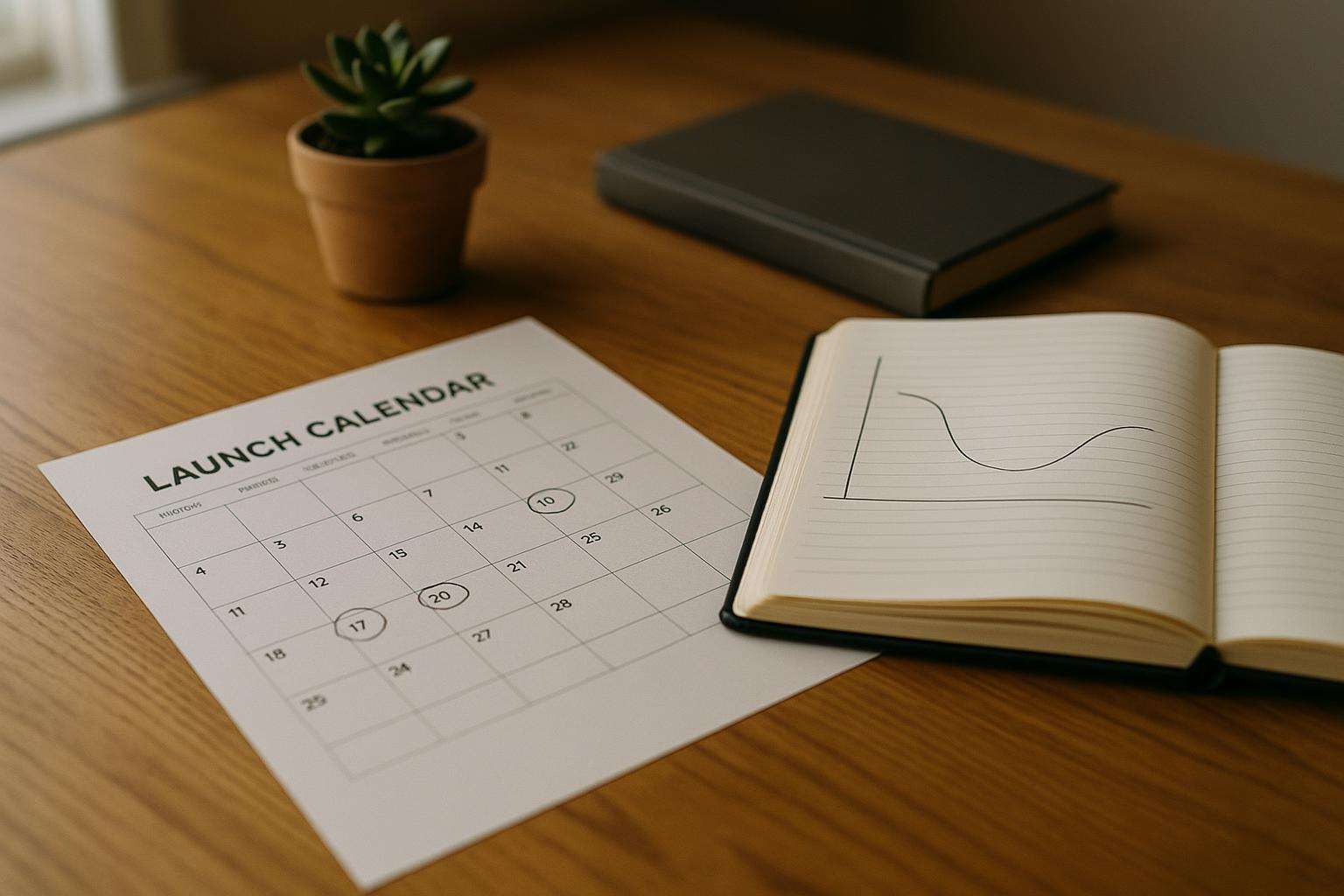
Planning for each cliff point before release — with a marketing calendar that has explicit activations scheduled at day 14, day 28, and day 60 — is the defining difference between launches that sustain and launches that spike and vanish.
How Does Amazon's BSR Decay Formula Work After Launch Week Ends?
Amazon's Best Sellers Rank is not a lifetime scoreboard. It is a continuously decaying measure of recent sales velocity. The working approximation of the formula, confirmed by community reverse-engineering analysis of actual BSR data:
New Score = Today's Sales + (Yesterday's Score ÷ 2)
With a half-life of roughly 24 hours per scoring cycle, a book that goes quiet sees its rank worsen within six to twelve hours and fall dramatically within 48 to 72 hours.5 One detailed reverse-engineering analysis found that sales from two hours ago carry approximately ten times the ranking weight of sales from two days ago, with the primary BSR recalculation occurring at 2–4 a.m. EST.6 Official Amazon KDP documentation confirms the principle: “Recent activity is weighted more heavily than historical activity.”
The most important consequence of this formula is the momentum asymmetry: reaching a rank costs roughly twice the daily sales required to maintain it once established. An analysis of the decay formula puts it at approximately 40 sales to initially hit a given BSR rank — but only about 20 sales per day to hold it once momentum is established.5 This asymmetry defines the core opportunity of sustain-phase strategy: crossing the 30-day cliff with rank intact means the daily sales effort required to stay there is roughly half what it cost to get there.
| Overall Kindle BSR | Est. Daily Sales | Est. Monthly Sales |
|---|---|---|
| #5,000 | ~30 | ~900 |
| #10,000 | ~20 | ~600 |
| #50,000 | ~4–5 | ~120–150 |
| #100,000 | ~1–2 | ~30–60 |
These figures are calibrated to late 2025 and cross-referenced across Kindlepreneur, BookBloom, and TCK Publishing;7 verify against a live calculator before making budget decisions on them. The power-law shape of the curve is what matters: the gap between BSR #100,000 and #10,000 — a 90,000-place climb — is only the difference between one or two daily sales and twenty. Sustaining rank near #10,000 is achievable with modest, consistent daily velocity, and the momentum asymmetry means it costs less to hold than to reach.
How Should You Ramp Down Amazon Ads to Avoid a Post-Launch Collapse?
The most destructive sustain-phase mistake is cutting ad spend the moment the launch window closes. Eliminating advertising at the same time the New Release boost fades creates a double-deceleration that collapses BSR within days. The correct move is a deliberate phase transition across three periods — not a stop, not panic cuts, but a planned reduction on a calendar.
The Three-Phase ACoS Ramp: During the Launch phase (Days 1–14), target 80–100%+ ACoS — the explicit cost of purchasing algorithmic position and feeding the sales velocity signal, not a sign of campaign failure. During the Ramp-Down phase (Weeks 3–8), pull back to 50–70% ACoS as rank stabilizes and the algorithm begins building conversion history. In the Sustain phase (Month 3+), optimize toward 30–40% ACoS — genuinely profitable at the 70% royalty tier, where break-even ACoS equals 70% of list price. After launch week, reduce total ad spend to 30–50% of launch-week levels, never to zero.8
The metric that reveals whether this strategy is compounding is TACoS (Total Advertising Cost of Sale): your ad spend divided by total revenue including organic sales. When TACoS falls while ACoS holds steady, ads are generating organic rank and recommendation-engine traffic beyond directly attributed clicks — the flywheel is spinning.9 If TACoS is flat or rising, ads are propping up all revenue with no compound effect. A healthy sustain-phase TACoS lands in the 10–15% range; above 20%, organic velocity is absent. An author who pauses campaigns because ACoS looks high may be destroying a campaign generating 40% organic lift — making the effective TACoS an excellent 35%. ACoS in isolation is a misleading metric during the sustain phase.
Mark Dawson's team demonstrated this principle in documented launches: after the launch promo window, maintaining Amazon Ads and Facebook campaigns at reduced budgets while tracking KU page reads allowed series read-through economics to turn apparent ACoS losses into actual gains — because each Book 1 sale was generating revenue from Books 2 through 4. The playbook detail is covered in the Self Publishing Formula episode documenting Dawson's post-launch ad approach.
How Do You Build a Favorable Also-Bought Map During the Sustain Phase?
Amazon's recommendation engine — the “Customers Also Bought” carousel and the personalized recommendation emails it powers — is estimated to drive 35% of all Amazon revenue and is responsible for most of the sales indie authors never directly caused themselves. For authors, this is the free engine that can sell your book for years without ad spend. But it must be seeded correctly or it works against you.
The mechanics as of 2026: also-boughts begin populating at roughly 50 paid sales on Amazon US and refresh twice a week (Thursday and Sunday evenings). A book needs a minimum of 10 reviews to appear in also-bought carousels at all;10 below that threshold, the recommendation engine cannot activate and promotional traffic converts poorly without social proof. The 30-reviews-in-30-days target is a published practitioner milestone — review velocity is itself a discovery signal Amazon weighs.1
Crossing genre boundaries in launch promotions corrupts the also-bought map in ways that are expensive to undo. In one documented case, promoting a historical-fiction title to a writing-craft audience filled the also-boughts with writing-craft books — Amazon then routed recommendations to readers who wanted to write books rather than read historical fiction — and recovery required a corrective promotion larger than the original damage.11 The rule is firm: cross-promote only with authors whose readers buy and finish your genre, timing simultaneous discounts so buyers purchase both titles in the same session, engineering mutual also-bought neighbor links between genre-matched titles.
After launch, monitor also-boughts monthly using a tool such as Yasiv to detect contamination (wrong-genre neighbor titles appearing in the carousel) and to identify cross-promotion candidates whose recommendation neighborhoods closely match your own. One clean also-bought map with the right genre neighbors is worth more than a large promo budget pointed at the wrong audience.
What Is the 60-to-90-Day Promo Pulse, and When Do You Use It?
Sustaining rank past the 90-day new-release window requires periodic re-ignition. The practitioner consensus is a promo pulse every 60 to 90 days — each burst creates a compounding rank wave that re-seeds the also-bought map with fresh buyer pairs, generates new review velocity, and triggers recommendation-engine signals.12 Running promotions more frequently risks the discount-dependency signal: promotions on more than 30% of days have been associated with ranking drops of 20–35% when the book returns to full price, because the algorithm learns the book's true price is the discounted one.
The most powerful single-burst mechanism available is the BookBub Featured Deal — capable of delivering 5,000 to 41,000 free downloads in documented launches, rank spikes into the Kindle Store top 100, and KU page reads running 2–3× above pre-deal baseline for months afterward.13 One documented series launch: a Book 3 BookBub deal run six days after a Book 4 launch drove Book 3 to Kindle Store rank #69 on deal day and held Book 4 below BSR 10,000 for a full month — exactly the cliff-bridging second rank wave, timed deliberately to offset the 30-day New Release fade.13
The ideal timing for a post-launch BookBub application is Days 14–21, just as the New Release boost is fading, to create a second rank wave that offsets the first cliff. BookBub accepts one featured deal per author per 30-day window; acceptance rates run approximately 10–20% of US submissions, so apply early and build a newsletter-stack backup for cycles when the deal does not land.14
Between BookBub deals, a stack of three to seven genre newsletter sites (Bargain Booksy, Robin Reads, Freebooksy, Fussy Librarian) across three to five consecutive days provides a measurable rank pulse at $25–$100 per slot, combined with a Kindle Countdown Deal to preserve the 70% royalty at the discounted price.12
The economic foundation beneath all of this is series read-through. The sustain strategy only compounds when readers advance from Book 1 to subsequent titles. The benchmark thresholds from practitioner and community data: Book 1 to Book 2 sell-through of 50–60% for paid sales and 75–86% for Kindle Unlimited borrows is considered normal.15 A five-book series with 65% book-to-book read-through generates approximately $9.50 in total royalties per KU reader versus $1.89 for a standalone. Below 50% paid sell-through from Book 1 to Book 2, diagnose the underlying product — the ending hook of Book 1, the backmatter link to Book 2, and the price gap between titles — before scaling post-launch ad spend. Fix the read-through rate first; then invest in sustain infrastructure.
This is the paid-plus-organic flywheel in its completed form: ads buy the velocity to ignite the recommendation engine; the engine delivers organic sales that lower TACoS over time; promo pulses every 60–90 days re-inject the signals that sustain organic placement between campaigns. The 30-day launch cliff is not a disaster to survive once. It is a threshold to cross deliberately — then hold above — by building the infrastructure before the release date.
Frequently asked
What causes the 30-day launch cliff on Amazon?
Amazon gives every new book an undisclosed but empirically documented algorithmic boost, often called the Honeymoon Factor, which indexes the title for more keyword phrases at better positions than equivalent older books receiving the same daily sales. This boost fades across three scheduled cliff points: Day 30, when the book exits the Hot New Releases list; Day 60, when a second algorithmic evaluation further downweights the new-release premium; and Day 90, when Amazon stops treating the title as new. The cliff exists because Amazon's Best Sellers Rank uses a time-decay formula where recent sales carry far more weight than older ones — the score halves roughly every 24 hours without fresh sales. A book that generates strong launch-week rank but receives no sustained marketing activity will see its BSR collapse within a few weeks regardless of how well the launch itself performed. Planning specific marketing activations at each cliff point before release is what separates launches that sustain from those that spike and disappear.
How do I know whether my Amazon Ads are sustaining rank or just spending money?
The metric to watch is TACoS — Total Advertising Cost of Sale — defined as your ad spend divided by total revenue including organic sales. A flywheel that is working produces a falling TACoS over time: ads generate organic rank and recommendation-engine traffic, organic sales grow, and the share of total revenue funded by ads shrinks. If your ACoS holds steady at 50 percent but your TACoS is falling week over week, ads are compounding into organic value — that is confirmation the flywheel is spinning. If TACoS is flat or rising, ads are propping up all revenue with no organic compound effect. A healthy sustain-phase TACoS lands in the 10 to 15 percent range; above 20 percent, organic velocity is absent. Authors who pause campaigns because ACoS looks high may be destroying a campaign generating significant organic lift that only the TACoS figure reveals — ACoS in isolation is a misleading metric during the sustain phase.
What ACoS target should I use during the post-launch sustain phase?
Amazon Ads strategy should shift across three explicit phases calibrated to the new-release timetable. During the launch phase, covering roughly the first two weeks, the target is 80 to 100 percent ACoS or higher — the explicit cost of purchasing algorithmic position and feeding the sales velocity signal, not a sign of campaign failure. During the ramp-down phase, covering weeks three through eight, the target pulls back to 50 to 70 percent ACoS as rank stabilizes. By month three and beyond, the sustain-phase target is 30 to 40 percent ACoS — genuinely profitable at the 70 percent royalty tier, where break-even ACoS equals 70 percent of list price. Authors who optimize for a 30 percent ACoS too early — in weeks one or two — throttle the sales velocity the algorithm needs to index the listing at competitive keyword positions during the highest-leverage ranking window a new book will ever have. Set explicit phase-change dates on your marketing calendar and switch deliberately.
How do I prevent cross-promotions from corrupting my also-bought map?
Amazon builds also-bought recommendation tables from purchase co-occurrence: when enough people who bought another title also buy yours, Amazon wires the two together and routes future recommendations accordingly. The first buyers shape your recommendation neighborhood disproportionately, and the wrong early buyers wire your book to the wrong neighbor titles. Cross-promoting with a mismatched genre can corrupt the map in ways that are expensive to undo: in one documented case, promoting a historical-fiction title to a writing-craft audience filled the also-boughts with writing-craft books, and recovery required a corrective promotion larger than the original damage. The rule is strict: cross-promote only with authors writing in the same sub-genre whose readers buy and finish what you write. Time simultaneous discounts so buyers purchase both titles in the same session — engineering mutual also-bought neighbor links between genre-matched titles is the explicit goal of a genre-pure cross-promotion strategy.
How often should I run promotional campaigns after my book launches?
The practitioner consensus across multiple published frameworks is a promo pulse every 60 to 90 days — frequent enough to re-seed the also-bought map with fresh buyer pairs and generate new review velocity, but spaced far enough apart to avoid the discount-dependency signal. Running promotions on more than 30 percent of days has been associated with ranking drops of 20 to 35 percent when the book returns to full price, because the algorithm learns the book's true price is the discounted one. For each pulse, a stack of three to seven genre newsletter placements such as Bargain Booksy, Robin Reads, Freebooksy, and Fussy Librarian across three to five consecutive days provides a measurable rank wave at roughly 25 to 100 dollars per slot. Use Kindle Countdown Deals rather than direct price changes to preserve the 70 percent royalty during the discount window, and schedule each pulse at least three weeks in advance to secure the best newsletter slots.
What series read-through rate do I need before spending on post-launch sustain ads?
The sustain-phase economics only produce positive returns when readers advance from Book 1 to subsequent titles in meaningful numbers. The practitioner benchmark from community data: Book 1 to Book 2 sell-through of 50 to 60 percent for paid sales and 75 to 86 percent for Kindle Unlimited borrows is considered normal. Below 50 percent paid sell-through, the unit economics of post-launch advertising are negative — each dollar spent acquiring a Book 1 reader generates less than a dollar in total catalog revenue. A five-book series with 65 percent book-to-book read-through generates approximately nine dollars and fifty cents per KU reader across the full catalog versus roughly one dollar and eighty-nine cents for a standalone. If read-through falls below the 50 percent threshold, diagnose the underlying product before scaling ad spend: check the ending hook of Book 1, the backmatter link to Book 2, and the price gap between titles. Fix the read-through rate first; then invest in sustain ads.